Skoda's innovative bicycle bell "breaks" noise cancelling headphones
Skoda's latest innovation isn't for drivers - it's a bicycle bell that even people with noise-canceling headphones will be able to hea piese auto online.
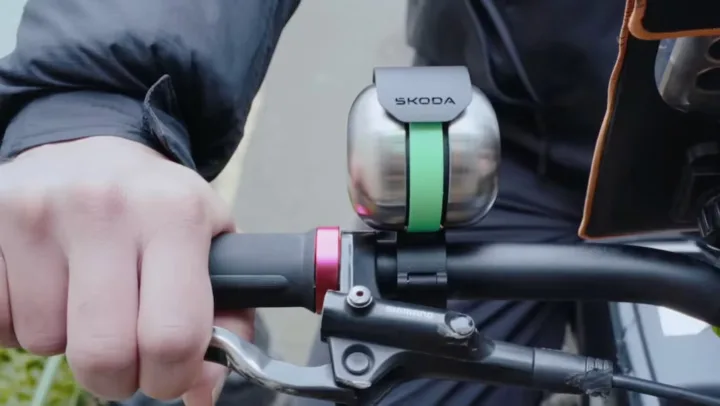
Skoda's new development is exceptionally not intended for the automotive sector: this time the Czech company has designed a bicycle bell. And this is not a marketing gimmick – the bell is designed to solve a real problem. It allows cyclists to send an audible signal even to pedestrians wearing noise cancelling headphones.
These special headphones are very popular because they suppress ambient noise. Many pedestrians and cyclists use them to listen to music or podcasts without being distracted by the sounds of traffic. In the so-called Active Noise Cancelling (ANC) technology, this is done by anti-noise: external noise is captured by a microphone and the electronics generate a sound wave with the opposite amplitude in real time. When the two signals meet, they isolate each other – which allows the desired silence to be achieved. However, the technology can also filter out warning signals – for example from a bicycle bell.
The new bell exploits two weaknesses of ANC
Skoda, together with scientists from the UK's University of Salford, has developed a solution to address this very problem. Their bike bell, called Duobell, exploits two weaknesses of ANC.
The first thing the development team discovered was that frequencies between 750 and 780 hertz are not effectively suppressed by many noise cancelling systems. The bell is specifically targeted at this range. Furthermore, it generates a higher, uneven tone whose sound waves cannot be processed quickly enough by the headphones.
Duobell does not need electricity
Although the principle of operation sounds complicated, Skoda's innovation does not require electricity and works entirely mechanically. In the clip released by the manufacturer, we can hear that the sound is exactly like a classic bicycle bell.
According to Skoda, in tests, pedestrians were able to perceive the signal up to 22 meters earlier than with conventional bells, even when wearing ANC headphones - this allows for up to five seconds more reaction time and is proof that the technology works. Thanks to it, pedestrians will be able to react significantly earlier when a bicycle approaches them.
However, the bell is not yet available for sale – it is only a prototype for now. Incidentally, Skoda is far from new to the world of cycling: the brand has been a sponsor and partner of the Tour de France since 2004 – and the first vehicles the company’s founders made were bicycles.
- 2026-04-13 - Bulgarian Lyuboslav Ruikov recorded his first victory in the Formula 4 rookie class
- 2026-04-12 - Abt reveals a sporty version of the future Audi A2?
- 2026-04-11 - Ford GT Mk IV – the fastest model on the Ring with only ICE drive
- 2026-04-10 - Good news for Formula 2: see when Nikola Tsolov's next start will be
- 2026-04-09 - Used cars up to 5000 euros: BMW 5 Series E39
- 2026-04-08 - Plovdiv becomes the epicenter of car culture: Gonco Fest 2026 arrives on May 9 and 10
- 2026-04-07 - 10 karting drivers from Plovdiv qualified for the national final of Red Bull Kart Fight
- 2026-04-06 - More and more Germans ready to buy a Chinese car
- 2026-04-05 - Panayot Nikolov also takes over the market in Central Asia and Transcaucasia
- 2026-04-04 - Citroen Berlingo turns 30