VW "breaks" with electrification in the US: why is this an important signal for the entire industry?
ID.4 production in Chattanooga (USA) will be discontinued and a typical large SUV by American standards will take its place. The situation overseas clearly reveals why the strategies of VW, BMW and Mercedes are failing and why Chinese manufacturers are pulling ahea piese auto online.
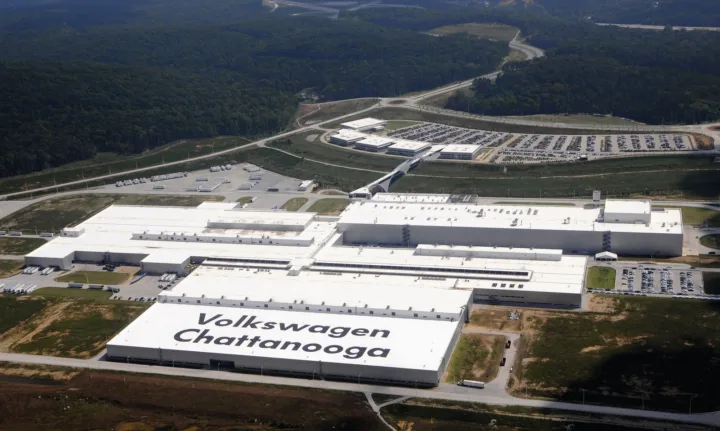
Chattanooga is located in the southeastern United States on the banks of the Tennessee River and is surrounded by forested hills and old industrial railway lines. In recent years, the city of 180,000 has transformed from a logistics and rail hub into a major center for the automotive industry. It is home to Volkswagen's only plant in the United States - and it is where the Wolfsburg-based giant produces its electric cars for the US market. However, production of these will be discontinued at the end of this month.
The plant is the largest industrial employer in the region – several thousand people are employed directly or indirectly at the heart of the German corporation. That is why the situation at the plant is not just a reflection of industrial policy – it is related to labor, structural changes and economic dependencies.
Production of the electric VW ID.4, for which the plant has been running at full capacity for months, will soon be halted. In its place, a large SUV powered by a conventional internal combustion engine will roll off the assembly line. Thus, VW responds to what American customers have always wanted.
Customers decide VW's future in the US
But the changes at VW's American plant mean much more, because they beautifully illustrate a fundamental problem for German automakers. And that is that they are forced to produce electric, hybrid, and conventional ICE models simultaneously - and it is precisely this "tear" that could lead to their failure.
“The Chattanooga plant has been and remains a cornerstone of Volkswagen’s strategy in the United States,” says Kiel Gruner, president and CEO of VW USA. Now the company wants to “adapt the center for long-term successful development through competitive products.” Such statements signal the urgent need for stabilization – and reveal a significant shift in the companies’ priorities.
The VW model that will continue to roll off the assembly line in Chattanooga in the future is called the Atlas – and it’s not known in Europe. It’s a large, angular SUV with a wide front end, a high hood, and a huge grille.
The Atlas looks imposing with its abundance of shiny chrome elements and body-piercing LED headlights – and viewed from the side, the car looks like a massive fortress on wheels, created for US Highways, suburbs and in general – for long-distance trips. Inside, there is plenty of space – with three rows of seats, a wide center console and solid materials. This is not another “polished” in many ways electric car, which was supposedly a leap into the future, but a real road giant that every American would like to have today.
Very few Americans drive electric
VW's sales statistics reveal how logical the company's decision was. In 2025, Volkswagen sold 329,800 cars in the US - of which only about 22,000 were the electric ID.4 model.
The sales were mainly driven by the Atlas (including the Cross Sport version) – of which over 100,000 units were sold, the Tiguan (approx. 79 thousand) and the compact Taos (approx. 55 thousand). Together, these three SUVs account for two-thirds of the brand's total sales in the US – and are 10 times higher than the ID.4.
Continue to the next page
- 2026-04-26 - Will a sporty GT from Korea appear soon?
- 2026-04-25 - Second FIAT and Leapmotor showroom opens in Sofia
- 2026-04-24 - Leapmotor launches its first sports electric car in Europe
- 2026-04-23 - A new whirlwind over Europe - the Auto 1 award for the Passat (retrospection)
- 2026-04-22 - Honda Accord turns 50
- 2026-04-21 - Toyota beats Ferrari on the Italians' "home" track
- 2026-04-20 - Citroën records solid sales growth in the first quarter
- 2026-04-19 - Mercedes SLR 722 S McLaren Edition goes up for auction
- 2026-04-18 - 20 years ago, a Bulgarian made his debut in Formula 3
- 2026-04-17 - Video reveals how quickly a pileup can happen on the highway