ARO 24: the off-road vision of socialist realism
In the early years of socialism, the production of standard off-road vehicles in the Eastern Bloc was concentrated mainly in the USSR, and only in the GAZ and UAZ factories (before the appearance of the VAZ-2121 Niva). However, as early as 1957, the production of this specific type of dual-purpose vehicle was mastered in Romania. The newly established ARO company initially offered an almost exact copy of the GAZ-69, but relatively soon after, it began developing an off-road model with its own much more modern design. Thus, in 1969, after a six-year design period, the first original version of the ARO was presented magazin de piese auto online.
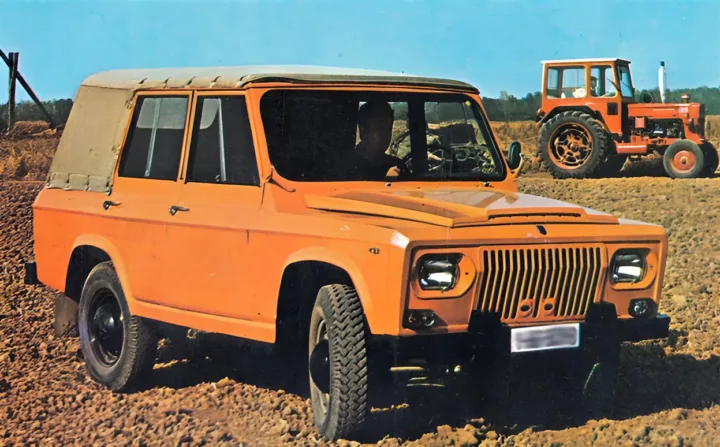
The first mass-produced model of this type, designated 240, had an open body with a canvas roof and 2 doors, independent front suspension, 4-speed gearbox, four-wheel drive and a new 2.5-liter engine with 75 hp. Sales abroad began after 1973, but export models had other engines to meet emissions standards. In 1975, the 241 models were launched, also with a soft-top roof, but with 4 doors, and the cargo-passenger 243 with two doors and an all-metal closed body. In 1978, the first variants equipped with Brașov D127 diesel engines with a capacity of 3119 cc and 68 hp were presented. In 1976-1977, the 5-door 244 models also debuted, as well as the 320 pickup truck, based on an extended ARO 24 chassis.
The first ARO 24 series was distinguished in appearance by a separate radiator grille, rectangular headlights from the Dacia 1300 and taillights from the Romanian-made Bucegi truck, but after 1976, headlights from the Bucegi were also used, as well as a new type of taillights.
In 1984, a new plastic grille was introduced, which integrated 2 round headlights (on the 243 models), 4 round headlights (mainly on the 244) and 2 rectangular headlights from the Dacia 1300 (on the 241, 242, as well as on the 243, 244). From the same year, there was also a new dashboard with new instruments from the Dacia 1310.
A 5-speed gearbox was introduced in 1985, as well as optional disc brakes on the front wheels. Also at that time, a variant with the new 2.6-liter, 69 hp Câmpulung D27 diesel engine with indirect injection was launched, which could reach a speed of 115 km/h.
The model was partially restyled in 1994, with a slightly elongated grille and taillights from Oltcit, and in addition to versions with Romanian engines, variants with Perkins, Cosworth Ford, VM Motori, Renault, Peugeot-Indenor, Toyota and Andoria engines (2.4-liter turbo, Euro 3) were now also available.
The ARO 24 was well received in both socialist and capitalist countries. It also participated in the Paris-Dakar rallies and was also exported to some African countries, India, the USA and South America. It was produced under license, even in countries such as Spain (1980–1990) and Portugal (1975–1995) under the trade names Hisparo and Portaro. Production in Romania continued until 2006.
- 2026-09-21 - Top 10 12 to 13 year old models according to TÜV: Audi Q5 (8R)
- 2026-09-19 - "Moskvich" 403: the transitional model
- 2026-09-18 - Mercedes CLS 63 AMG Shooting Brake: the most beautiful Benz station wagon in history has a cherry trunk floor
- 2026-09-17 - Powerliner: new generation of powertrains for higher efficiency from Mercedes-Benz Trucks
- 2026-09-16 - Renault saves fuel with the help of a computer 45 years ago
- 2026-09-15 - Mercedes now holds the record for most Formula 1 wins alongside Ferrari
- 2026-09-14 - The Maserati legend comes to Bulgaria - a retrospective
- 2026-09-13 - The new Spring – no longer from China, but from Slovenia (VIDEO)
- 2026-09-12 - Wind in your hair, flies in your teeth and 9000 rpm: the new Porsche 911 GT3 S/C (VIDEO)
- 2026-09-11 - Škoda Beta: 30 years ago another Bulgarian project failed