Renault Dauphine - a French touch on the Bulgarian market during communism
The sales realized by Renault in Bulgaria during the years of socialism remain unparalleled in terms of volume, even against the background of the most developed countries of the Eastern Bloc. The first successful step towards conquering the closed automobile market of the People's Republic of Bulgaria was made back in the late 1950s with the Dauphine model. After a seven-year absence from Bulgaria, the state-owned company Renault resumed its participation in the Plovdiv Fair in September 1956 and officially returned to our market a few months later. In the following years, deliveries gradually increased and in 1960, the number of cars of the French brand of the 4CV and Dauphine models that reached our private customers was already 40, and in 1961 - as many as 185. The price of the Renault Dauphine in 1960 was 21,500 BGN, and in 1961 it became 25,000 BGN (or 30 average monthly salaries) piese auto online.
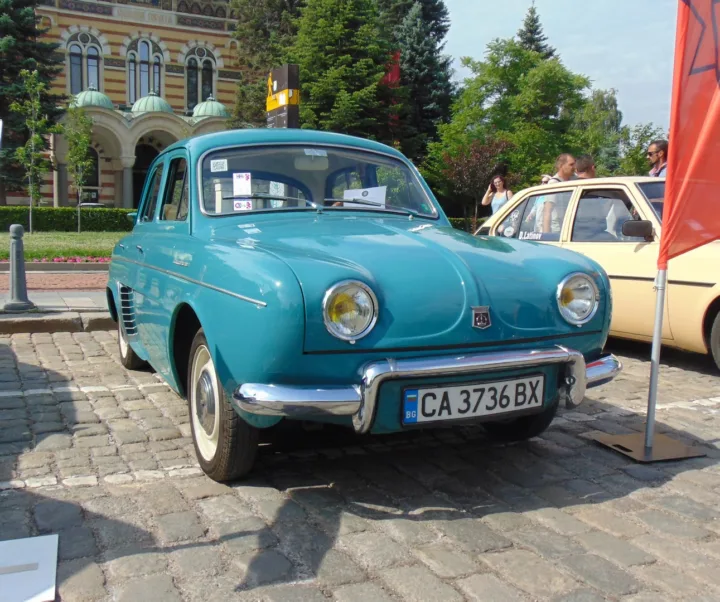
A small part of the Dauphine cars delivered to our country in those years have been preserved to this day, and individual units of them have been restored to their most authentic appearance. Of these, the one owned by Petar and Hristo Babachevi, one of the greatest connoisseurs of the French brand, deserves special attention, in whose collection there are several unique Renault cars, completely restored by them. The oldest copy they own is of the Dauphine model. The car was purchased on January 30, 1960 from the Central Department Store by their father Ivan Babachev. It was actively used until September 13, 1996, after which it was taken out of service and stored in a garage. In 2005, at the celebration of his 80th anniversary, the owner gave the car to his two sons.
Just a few months later, they undertook a complete restoration, which was fully completed in May 2008. All restoration work, except for painting, reupholstering the interior and chrome plating the bumpers, was carried out by Petar and Hristo. During the repair of the body, which took the most time, corrosion was removed from all surfaces, and the perforated areas were replaced with new sheet metal. The upholstery of the front and rear seats, as well as the door trim, were replaced with new ones that were as close to the original as possible. The upholstery on the ceiling is original. The complete painting was carried out by professional car painter Plamen Stoyanov. The seals on the windshield and rear windows were ordered and delivered from France. All handles, locks and windows have been preserved in their original form.
A complete engine overhaul was performed, with the standard MAHLE segments, main and connecting rod bearings replaced. All gaskets, the clutch disc, the clutch cable and the timing wheel were also replaced, and the water pump was repaired. The brake system was thoroughly checked, with all the rubber seals on the master brake cylinder replaced. The electrical installation was converted to 12V with an alternator and relay-regulator from Renault 12. New headlight reflectors and new stop lights, delivered from Canada, were installed.
Conclusion
The Dauphine was an ordinary, mass-produced and generally accessible car in France in the 1950s. However, in Bulgaria its significance in the context of the socialist automobile market was much greater. In addition to being sold for leva, albeit for a short period of time, it served as an objective basis for comparison between the Western standard and the level of the Eastern European automobile industry.
- 2026-04-08 - Plovdiv becomes the epicenter of car culture: Gonco Fest 2026 arrives on May 9 and 10
- 2026-04-07 - 10 karting drivers from Plovdiv qualified for the national final of Red Bull Kart Fight
- 2026-04-06 - More and more Germans ready to buy a Chinese car
- 2026-04-05 - Panayot Nikolov also takes over the market in Central Asia and Transcaucasia
- 2026-04-04 - Citroen Berlingo turns 30
- 2026-04-03 - Mercedes-Benz's light truck range goes on tour in the country
- 2026-04-02 - Used cars up to 5,000 euros: Toyota Auris
- 2026-04-01 - BYD Seal 08 charges 400 kilometers in just five minutes
- 2026-03-31 - Citroën with its own repatriation vehicle (retrospection)
- 2026-03-30 - This is how a used car scam works on the Internet