Creative freedom in socialist Poland: the cross between Fiat 126P and Polonez
How a Zastava 750 could evolve into a Polski-FIat 126P, which looks like a Polonez with a VW Golf silhouette piese auto online.
During the socialist era, the situation on the car market was the same almost everywhere in the Eastern Bloc: a very limited range, archaic designs, lack of choice in colour, modification and extras, and, of course, the mythical waiting in line. However, the desire to own a vehicle with a strong individuality in many cases turned out to be stronger than the artificially imposed commercial and industrial frameworks and financial obstacles. In many cases, imagination (both in creating a non-standard project and in providing the funds for its implementation) managed to overcome the numerous limitations. Thus, behind the "iron curtain" dozens of original vehicles were born, some of which were distinguished by original and quite successful stylistic solutions.
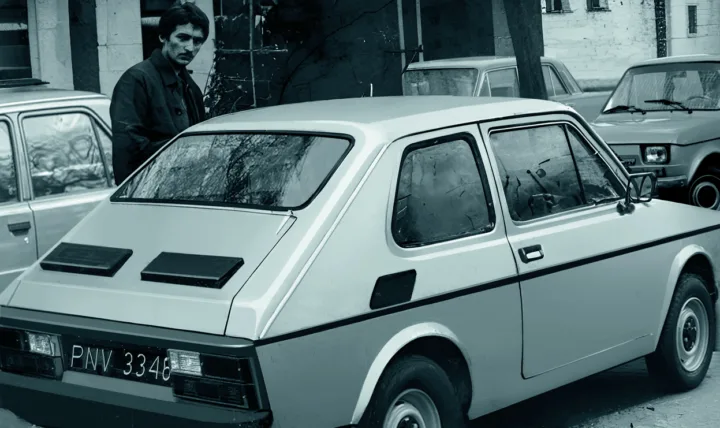
One of them was made in the small Polish town of Nadziejow near Środa Wielkopolska in 1988. Its author is Zdzisław Ulman, who in 1986 bought an almost 20-year-old Zastava 750 in a rather poor condition. He tried to repair it, but later realized that in order to achieve the desired result, he would have to do everything from scratch. As a bodywork specialist and auto mechanic, he decided to put all his ingenuity and talent into the reworking of the vehicle, which he didn’t really like in terms of design anyway. He found a scrapped Fiat 126P body somewhere, which he put in place of the Yugoslav one, while lengthening the chassis by about 30 cm. For some of the operations, he used a special welding machine in the factory where he worked. The rear lights and bumper, as can be seen from the only known photo, are from Polonez. Ullmann also made a completely new dashboard and installed new, more modern seats from another car. In the end, only the engine remained from the old car.
The silver-painted car, parked in front of Zdzisław Ulman's workplace, immediately became a major attraction. The impressive bodywork not only aroused great interest among his colleagues and passers-by, but even attracted some potential buyers. In 1988, the car was registered with the Ministry of Motor Vehicles as "Sam 87", but the designer added his initials "ZU" to the name.
- 2026-09-21 - Top 10 12 to 13 year old models according to TÜV: Audi Q5 (8R)
- 2026-09-19 - "Moskvich" 403: the transitional model
- 2026-09-18 - Mercedes CLS 63 AMG Shooting Brake: the most beautiful Benz station wagon in history has a cherry trunk floor
- 2026-09-17 - Powerliner: new generation of powertrains for higher efficiency from Mercedes-Benz Trucks
- 2026-09-16 - Renault saves fuel with the help of a computer 45 years ago
- 2026-09-15 - Mercedes now holds the record for most Formula 1 wins alongside Ferrari
- 2026-09-14 - The Maserati legend comes to Bulgaria - a retrospective
- 2026-09-13 - The new Spring – no longer from China, but from Slovenia (VIDEO)
- 2026-09-12 - Wind in your hair, flies in your teeth and 9000 rpm: the new Porsche 911 GT3 S/C (VIDEO)
- 2026-09-11 - Škoda Beta: 30 years ago another Bulgarian project failed