Opel OSV 40: the battle for safety began half a century ago
Electrified, emotional and yet equipped for all everyday tasks – that applies to Opel’s modern cars, from the Corsa and Astra to the new Grandland. Both passenger cars and commercial vehicles from Opel have one thing in common: they ensure a relaxed journey at all times with numerous active and passive safety systems. Safety is a tradition at Opel, in every vehicle class. Seat belts have been standard equipment since 1973, a full three years before they became mandatory, and in 1974, Opel launched its comprehensive safety vision. The experimental Opel Safety Vehicle (OSV) based on the production Kadett C was then presented, which survived a frontal impact at a speed of 40 miles per hour (almost 65 km/h) and set an important direction for the further development of safety features. The impact speed in miles is given the numerical index 40 piese auto online.
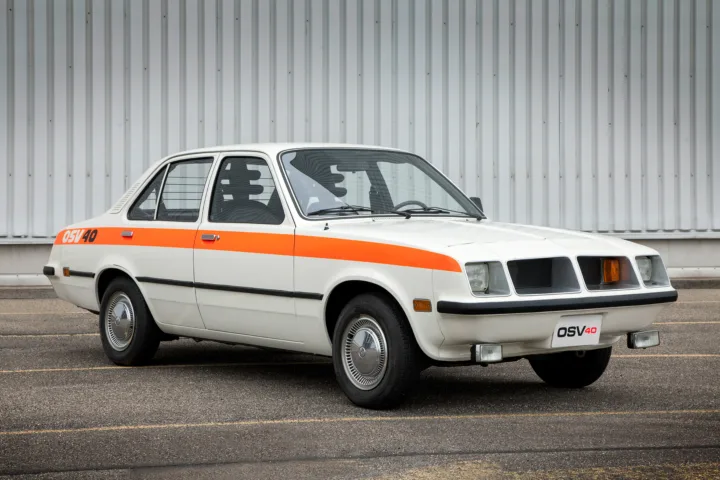
A little over half a century ago, the Rüsselsheim company presented its idea for a safe compact car at the International Technical Conference on Enhanced Vehicle Safety in London. Despite the additional equipment, the car weighed only 960 kg, with which Opel engineers showed that optimal passive safety could be effective not only with large and heavy vehicles, but also with compact cars. In the tests carried out, the OSV 40 achieved all the goals set: All four doors could still be opened without the use of tools after a frontal impact with a hard obstacle at 65 km/h. The OSV 40 was equally safe in a frontal impact with a pylon at 50 km/h, a rear impact, a side impact with a pole and in a rollover at 48 km/h. Compared to the sheet metal bumpers of the time, the volume buffers of the OSV 40 were filled with polyurethane foam, which gave them shock-absorbing properties. This was the forerunner of the “self-healing” bumper. Engineers also fill the cavities of the sills and doors with polyurethane foam to create increased safety reserves in a side impact.
Reinforced roof beams and unique headrests on the front seats mounted on the inside of the ceiling increase the stability of the passenger compartment, while the seats can still be adjusted. All surfaces in the passenger compartment that passengers can come into contact with in the event of an accident are covered with a two-centimeter layer of polyurethane foam. The steering is equipped with an additional folding element in the lower section of the steering column to better absorb energy in the event of an impact. The central warning system, manufactured by Hella, controls 11 functions and indicates possible errors by switching on the corresponding warning lights. The four seats of the OSV 40 are equipped with three-point seat belts, the front ones having an automatic tensioning system.
The impact of the OSV 40 was enormous, and the results of the development and testing of the car were soon directly applied to the production of new models. At the same time, the experimental car also contributed to the slowly changing public consciousness. Until then, issues related to safety and accident prevention were not particularly important to people, unlike today.
- 2026-10-24 - "Battle of the Motorcycles": The automotive history of Tsarist Russia comes to life in spectacular action
- 2026-10-23 - The reborn Alpine A310 (VIDEO)
- 2026-10-22 - The new Smart for under 20 thousand euros - all the most important things (VIDEO)
- 2026-10-21 - VW with a service campaign for over 70,000 electric vehicles – due to fire risk
- 2026-10-20 - A revolution in vans: Renault's new "loaders" are computers on wheels (VIDEO)
- 2026-10-19 - Citroën AX turns 40
- 2026-10-17 - Mercedes is not kidding: a new type of artificial intelligence will drive the car itself
- 2026-10-16 - Star 660: the first ceremonial truck used by the Vatican
- 2026-10-15 - Gunsch 130 Rapid: Škoda's most extreme sports coupe was created 40 years ago
- 2026-10-14 - Renault E-Space Concept: a spaceship for the whole family (VIDEO)