Renault 25: a sense of luxury from the 80s
After the end of World War II, the Renault company was nationalized and had to give up its prestige models, and Renault's long-delayed return to the semi-luxury segment only happened in the spring of 1975 with the Renault 30 piese auto online.
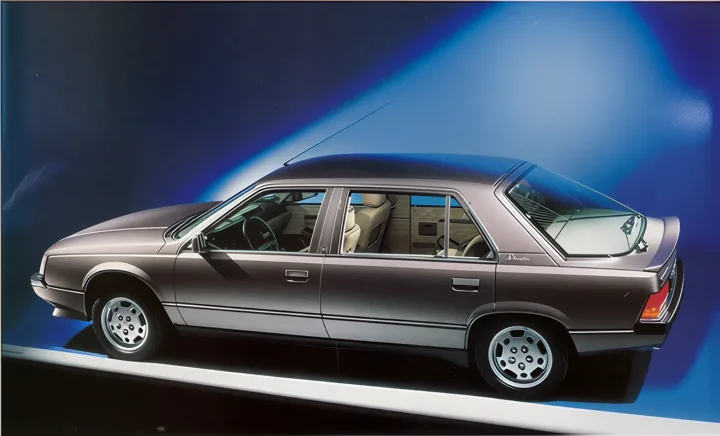
However, this model did not sell well for various reasons, such as the problematic PRV engine (a joint development of Peugeot, Renault and Volvo), the tasteless design style, questionable quality control, and above all because of Renault's long-lost image in this segment. But the company did not lose hope and in 1979 began the development of its next luxury model. As a result, the Renault 25 appeared, presented at the Paris Motor Show in 1983, with its sales starting in the spring of the following year. It was equipped with basic 2-liter gasoline and diesel engines, while the luxury versions received a V6 engine - one of the key prerequisites for its success. A sufficiently eloquent example of this is that all units sold of the Renault 30 and its cheaper version Renault 20 taken together were less than those of the Renault 25.
In late 1983, then-President François Mitterrand visited the Heuliez factory in western France. At the same time, the famous coachbuilder, who had become quite a major player in the boutique car market, was finalizing his own interpretation of the long-wheelbase Renault 25. Mitterrand, who at the time was only using the Renault 30, apparently liked this prototype and ordered an armored version to be delivered to the Élysée Palace. This marked the triumphant return of Renault as the preferred transporter of the French head of state. Until then, the most frequently used car by French leaders had been the Citroën, and it was not until the late 1970s that President Giscard d'Estaing broke with dogma, preferring to drive a Peugeot 604 (both a standard model and an armored long-wheelbase sedan produced by Heuliez).
Meanwhile, Heuliez equipped its factory with modern and very expensive phosphating and painting equipment, as well as several new independent assembly lines, one of which was intended solely for the production of the Renault 25 Limousine. Renault gave the green light to the project, which was to become a competitive analogue of the popular limousine created by Heuliez, based on the Peugeot 604. However, the fundamental differences in design between the two cars were significant. For the reworking of the 604, Heuliez simply lengthened a standard Peugeot sedan, while for the Renault 25 Limousine the car had to be completely redesigned. The bodywork was delivered from the Sandouville plant, disassembled, lengthened, reassembled on welding molds and then passed through the assembly line for further processing.
The main problem with the R25 Limousine is that it's too expensive for what it offers. The version equipped with the V6 Turbo engine costs over four times as much as the base 2-liter R25, and all this for 23 cm of extra legroom in the back and no headroom (which is why even a president like Jacques Chirac, at 190 cm tall, definitely feels more comfortable in his old Citroën CX Prestige). In the small world of luxury limousines, you expect a little more exclusivity for a similar price.
The basic V6-powered variants were a 2.7-liter direct-injection with 144 hp, and a 2.5-liter turbo with 182 hp and quite good acceleration. Compared to the long-wheelbase Citroën CX Prestige (produced nearly 22,700 times), the luxurious extended version of the Renault 25 turned out to be too expensive, too low and too ambitious, but unable to recreate the spirit of the giant eight-cylinder Renault models of the 1930s. With its modest wheelbase, which is only slightly longer than the standard one, limited power and plastic dashboard, it can hardly pass for a truly plutocratic car of the Mercedes-Benz 600 rank.
By June 1986, only 806 examples had been produced, with over 600 sold in France. This was considered a failure by Renault's marketing department, which was expected to have better forecast the interest in such a car, especially in foreign markets.
- 2026-09-19 - "Moskvich" 403: the transitional model
- 2026-09-18 - Mercedes CLS 63 AMG Shooting Brake: the most beautiful Benz station wagon in history has a cherry trunk floor
- 2026-09-17 - Powerliner: new generation of powertrains for higher efficiency from Mercedes-Benz Trucks
- 2026-09-16 - Renault saves fuel with the help of a computer 45 years ago
- 2026-09-15 - Mercedes now holds the record for most Formula 1 wins alongside Ferrari
- 2026-09-14 - The Maserati legend comes to Bulgaria - a retrospective
- 2026-09-13 - The new Spring – no longer from China, but from Slovenia (VIDEO)
- 2026-09-12 - Wind in your hair, flies in your teeth and 9000 rpm: the new Porsche 911 GT3 S/C (VIDEO)
- 2026-09-11 - Škoda Beta: 30 years ago another Bulgarian project failed
- 2026-09-10 - Another Chinese model receives 5 stars for safety from Euro NCAP