SMZ-C3D: myths and facts about the legendary "Invalidka"
In the second half of the 20th century, the powerful hum of this unusual vehicle could be heard in the most remote corners of the Soviet Union. The small and unsightly stroller, unofficially called the “Invalidka” because of its main purpose, began to be produced in the early 1950s. Initially, it was in the form of a tricycle, but at a later stage of its evolution it acquired a slightly more attractive appearance and four wheels. It was made at the Serpukhov Motorcycle Plant (SMZ), and the first series, produced between 1952 and 1958, was called the S-1L, and later it was renamed the S3L. Then came the S3A model, which basically retained the same design, but now had four wheels piese auto online.
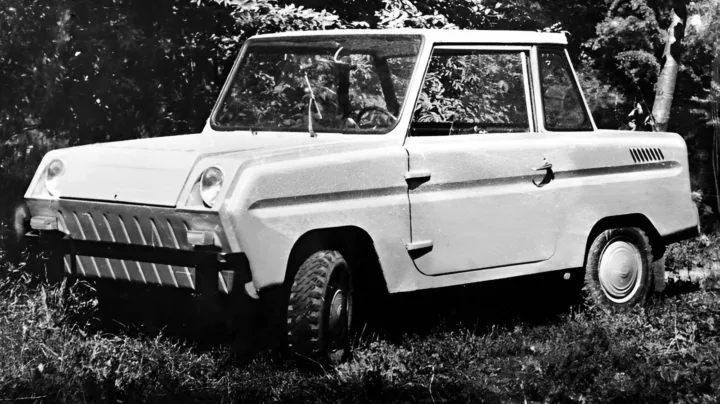
In the early 1960s, the design of a new generation of vehicles began, with specialists from NAMI, ZIL and MZMA joining the factory team. The first completed model under this program went into production in 1970 under the designation SMZ-S3D. It differed significantly from previous models in several key areas, such as the presence of a new motorcycle engine IZH-P2 and a relatively modern for its time, fully enclosed metal body. The springs in the front and rear suspension were replaced by torsion bars with longitudinal arms. For these reasons, it can be said that this is a completely different car, which shares with its predecessors only the two-seater concept with four wheels, as well as, of course, the steering principle, which is implemented through a system of levers.
Most Soviet-era motorists perceived the "disabled" vehicle as a poor and technologically backward product. This was due to the single-cylinder two-stroke engine, the extremely simple, albeit functional body design with a flat windshield, external door hinges, and the practically nonexistent interior.
The independent front suspension is combined into one unit with a rack and pinion steering mechanism, the brakes on all wheels are hydraulic, and the electrical installation is 12-volt (an interesting detail is that larger headlights from trucks and agricultural machinery were installed on later models).
The performance of the SMZ-S3D was inefficient, as the 500-kilogram car was powered by a 12-hp IZH-P2 engine, which turned out to be quite weak. That is why, as early as the fall of 1971 (just a year and a half after the start of production), the cars began to be equipped with a more powerful version of the same engine, designated IZH-P3. Its 14 hp. However, this did not solve the problem either, and the SMZ-S3D continued to be slow and noisy. With a driver, passenger and 10 kilograms of cargo, it could only reach 55 kilometers per hour. The SMZ-S3D was produced from 1970 to 1997, and over this more than a quarter of a century, a total of about 230,000 copies were made.
- 2026-03-02 - Peugeot 604: the American challenge
- 2026-02-28 - Volkswagen sells its 2 millionth electric car
- 2026-02-27 - The unsuccessful revival of the UAZ-469
- 2026-02-26 - New Mini-mum (flashback)
- 2026-02-25 - Partnership between winners - Yasen Popov and Mitsubishi
- 2026-02-24 - What brand is this truck? Warning - there's a catch!
- 2026-02-23 - Audi A6 Avant: a six-cylinder with hidden features
- 2026-02-22 - Will this decision take away the "joy of driving" at BMW?
- 2026-02-21 - Opel Corsa YES: special series with additional extras
- 2026-02-20 - "Traffic police" chased the trucks